
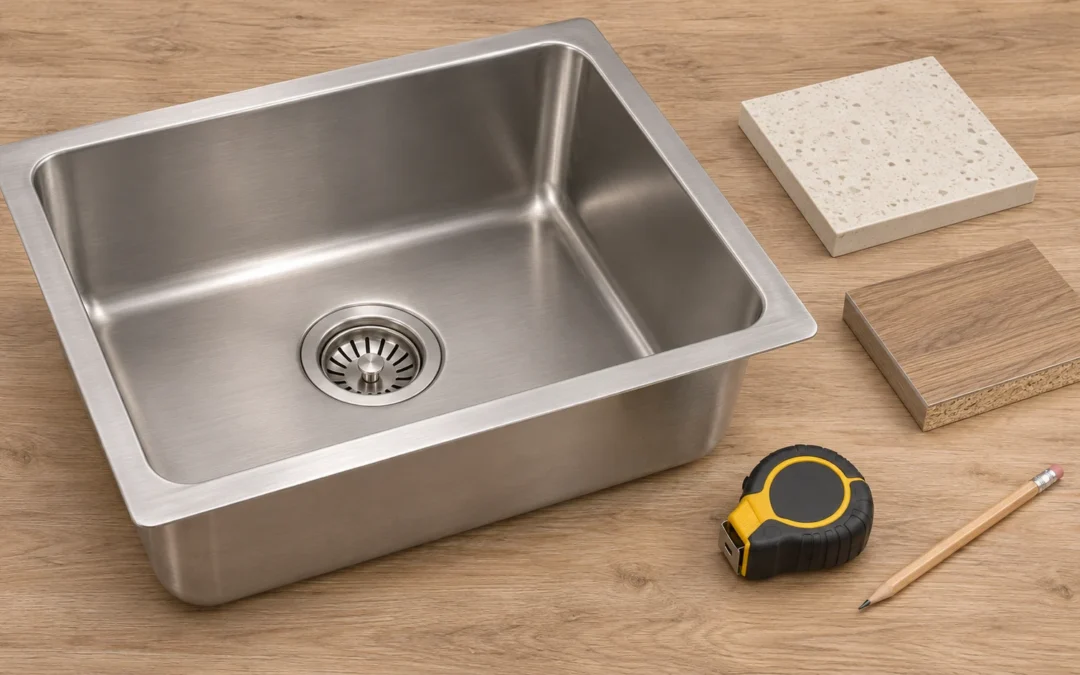
Choose your sink’s mounting style and exact model before the countertop is templated. An undermount sink sits below the counter and leaves its cut edge visible. A drop-in sink rests on top, with a rim covering the opening. Either can work well, but the right choice depends on the countertop, cabinet space and installation details, not just the look you prefer.
For a Niagara kitchen renovation, treat the sink, faucet, cabinet and countertop as one coordinated decision. A sink that looks perfect online is not a finished specification until the people measuring and installing it agree that everything fits.
Undermount or drop-in: the practical difference
Undermount: an uninterrupted counter edge
An undermount lets you wipe crumbs towards the bowl without crossing a raised sink rim. Its exposed countertop edge needs a suitable finish. Quartz and natural stone are common choices; compatibility still depends on the particular countertop system and fabricator.
Drop-in: a rim that covers the cutout
A drop-in, also called top-mount, has a visible perimeter lip. It is often the straightforward choice for conventional laminate counters, where the cut edge is not intended to remain exposed. The rim needs cleaning around it, but its presence is not a quality defect or a reason to dismiss the style.
BLANCO’s installation-type guide explains these differences. Do not assume that every sink can use either method. “Dual-mount” describes a model designed for both, subject to the appropriate installation instructions.
Start with the countertop you are actually buying
Ask the countertop supplier to confirm the proposed sink installation in writing. “Stone-look” describes an appearance, not a construction method. Equally, seeing an undermount in someone else’s laminate kitchen does not establish that it will work with your particular product.
If a supplier proposes an undermount system for laminate or another less familiar combination, request the specific compatible sink, countertop and installation requirements before ordering. Avoid turning a showroom example into a blanket rule.
Quartz does not automatically dictate undermount. Cambria’s installation FAQ confirms that its countertops can accommodate both undermount and drop-in sinks. Appearance, practicality and the rest of the design can therefore guide the choice once compatibility is established.
Check the cabinet, not just the sink’s advertised width
Start with the manufacturer’s minimum cabinet size, then have the actual installation checked. As one concrete example, BLANCO’s Canadian LIVEN 25 specification lists a 27-inch minimum cabinet and permits undermount or drop-in installation. That is a requirement for that model, not a universal allowance to apply to other sinks.
Give the installer a complete picture of the cabinet interior. Ask them to check:
- Whether the selected bowl and mounting arrangement fit the cabinet.
- Where drawers, waste pull-outs and other storage will sit.
- How the proposed bowl depth and drain location relate to existing plumbing.
- Whether the faucet’s hoses, weights or accessories have an unobstructed working space.
A wider or deeper bowl is only an improvement if the whole cabinet remains useful. Bring your largest baking tray or a measurement of it to the selection appointment, rather than choosing size from a photograph alone.
Agree on the reveal and support before cutting
With undermount, the “reveal” is the relationship between the countertop opening and the sink rim. A positive reveal shows some rim, a flush reveal aligns the opening with the bowl, and a negative reveal places the counter slightly over it. Ask to see a sample or drawing so that everyone means the same thing.
BLANCO’s PRECIS undermount instructions call for agreeing on the opening before cutting and comparing the template with the actual sink. They also identify potential cabinet obstructions and describe different support approaches. The appropriate method depends on the installation, so this is not a place for a universal do-it-yourself shortcut.
Ask who supplies and installs the support, and who checks it before the work is covered up. Also agree on faucet and accessory positions, including operating room for handles. Approving a sink location without discussing these details leaves important decisions unresolved.
A workable sequence from selection to reconnection
- Confirm the kitchen plan. Settle the cabinet layout and countertop material before finalising the sink purchase.
- Confirm the exact products. Share model numbers for the sink, faucet and accessories with the relevant trades. Check delivered items against the order.
- Prepare for templating. Cambria’s installation checklist calls for installed cabinets and plumbing fixtures on site at measurement. Follow your own fabricator’s requirements and have the decision-maker available.
- Review the final details. Record the mounting style, reveal where applicable, sink position and required holes before fabrication proceeds.
- Coordinate installation and plumbing. Confirm who removes the old counter, disconnects services, mounts the sink and reconnects the plumbing. Arrange the return visit around the actual installation and applicable curing requirements.
Do not assume that the countertop installer will also connect the faucet. Cambria’s checklist specifically distinguishes those responsibilities. Ask what must be ready for each appointment and when the kitchen can be used again, rather than promising yourself a same-day changeover.
If your project starts with a new surface on the existing cabinets, our guide to replacing countertops while keeping the cabinets covers the wider condition and support checks.
Keeping the existing countertop?
A replacement sink needs a separate assessment. Have the installer inspect the existing opening, its corners, the finished edge and access below. An advertised width alone is not enough to establish a match.
Before buying, ask: “Can this exact sink be installed in this existing opening, and what work would that require?” Do not plan the project around keeping the countertop until that answer is clear.
Common questions
Can I change the sink after templating?
Contact the fabricator before making a substitution. Ask whether fabrication has started and whether the replacement changes the opening or other details. A similar-looking model is not an automatic equivalent.
Does undermount mean maintenance-free?
No. Its easy wipe-down route does not remove the need to clean and inspect the joint. Ask for care instructions for both the sink and countertop.
What should I bring to a planning discussion?
Bring the sink and faucet model numbers, countertop selection, cabinet information and photographs of the existing plumbing. Include a list of accessories you want, even if you have not bought them yet.
Plan the whole kitchen detail
Homes By Adam’s kitchen renovation services include cabinet installation, backsplashes and planning. If you are renovating in Niagara, contact Homes By Adam to discuss the sink and countertop as part of the wider project before you commit to the final selections.
